
Rising: Post-Alaska plans

Can I just say, I’m astounded by the amount of food that teenage guys and men in their early twenties can eat without it affecting their waistline at all. Sometimes I sit at “family meals” here at TLC and just laugh to myself as my boys, fresh from their carpentry and aviation jobs, scarf down plate after plate of dinner.

To keep up with their voracious appetites (and because we don’t have the luxury of buying bread from a grocery store) I spend one, sometimes two afternoons a week baking bread for my students and staff. My students have gotten spoiled with homemade bread for sandwiches, toast, and to eat with the copious amounts of homemade soup that Tom and I feed them, and as much as they joke about becoming addicted to my “white people” cooking, I absolutely love having the time to spoil them a bit by baking them bread “with love”.

On a more selfish note, I love that my afternoons of baking give me an excuse to blast my worship music and twirl in my oven-warmed kitchen like a fool while breathing in the sweet scent that reminds me of my Tia’s kitchen on holidays. Baking has always been a stress reliever for me and I absolutely love that it’s become a part of my job description for this season of life.

RisingThe alchemy that occurs when I pour the ingredients into a mixing bowl, knead the dough that subsequently forms, and watch it rise in the ancient metal pans I found at village swap-meet astounds me. It just doesn’t make sense to me, this magic of baking, but it’s taught me a lot about life over the years. And if I’ve learned one thing this year through baking enough bread to feed a small army every week, it’s that you can’t rush the process.

When I try to hurry through my “memorized” list of ingredients, I inevitably forget the salt.

When I get over ambitious and try to make all six loaves at once, at least two somehow get screwed up.

When I convince myself that I need to rush, I don’t let the dough rise for long enough and my bread loses its beautiful, smooth top and its light, fluffy texture.

For someone who is, in the words of my car-obsessed grandfather, “All gas and no breaks”, spending time allowing my bread to rise seems like a waste, but it’s essential. The sitting and waiting, the patience, the “down time”… it’s essential in baking bread and I’ve been reminded that it’s essential in my walk with Christ.

In the last week or so, the Lord has brought me to a place of “rising”.

Since roughly December I’ve felt like someone put my brain inside my Kitchen Aid and turned it on high. As March has approached (aka the time of year when teachers usually begin signing their contracts for the next school year), my post-Alaska plans have been at the forefront of my mind. And in the last few months, the Lord has dumped what feels like nine million opportunities in my mixer with me and watched as I’ve spun and stressed and struggled, trying to figure out which is the “right choice” for the next season of life. Stressing and edging God out of the equation is so often my default reaction to seasons of change, even though I know deep in my heart that all I need to do is quiet myself before Him and ask (slash trust Him) to lead me.

I debriefed all of this with one of my most dear friends today (while our day’s worth of bread rose). She laughed and fed me the exact advice that I’d given her last summer when she was stuck on spin-cycle with Jesus.

“I don’t think God is going to tell you where He’s leading you, Kacy. I think He’s just going to let you sit and enjoy your time with Him, and then He’s going to take you there. I think you just need to wait and see; be silent and follow as He leads, one step at a time.” (Ironic advice given the number of times Exodus 14:14 has come up in our conversations with and prayers for each other throughout the last several months: “The Lord will fight for you; you need only be silent.”)

As I sit at my kitchen table this afternoon with pans of bread slowly rising next to me in my window sill, I know this to be true. This is to be a season of patience and listening, waiting and “rising”– not hurrying to get to the next thing on my to-do list or rushing my proverbial “baking”process… (or running full speed ahead into the obscure darkness, which almost seems like a shame because I’m SO much better at all of those things. #sarcasmfont)

I’m not gonna lie—I’m hungry and am anticipating eating the magical smelling bread next to me, almost as much as my heart is anticipating seeing what the Lord is going to do with my life next. As it currently stands, there’s a very good chance that three new countries and the ability to help found a non-profit that Denver drastically needs are in my immediate future… But all of that seems to be another blog for another time. Plus, I need to get off my tush and put this next round of bread in the oven before no one has anything to eat for dinner tonight.

I would love it if you would join your hearts in prayer with me as I wait and “rise”, sweet friends. Jesus is up to something… I have no idea what it is, but in the words of the United Pursuit song that I love so much, I know “It’s gonna be wild, it’s gonna be great, and it’s gonna be full of Him.”

PS: If you need to find yourself needing to breathe and pray, to quiet yourself and bake some bread today, here is the recipe that I’ve fallen in love with, courtesy of the lovely Mrs. Sarah Wardell.

Basically Manna from Heaven Recipe

  • 3 c. warm water
  • 2 tbsp. active rise yeast
  • ¼ c. agave or honey
  • ¼ c. coconut oil
  • 1 tbsp. salt
  • 5-8 c. flour

Mix warm water, yeast, and agave in your mixer for roughly a minute. Let the mixture sit for a few minutes to allow the yeast to proof. Slowly mix in the flour, oil, and salt until your dough forms. Mix/knead the dough with a bread hook for five-ish minutes. Spray your bread pans with non-stick spray and allow the bread to rise for thirty minutes. Bake at 375* for thirty minutes. Makes two sandwich loaves. (Disclaimer: This temperature and time works well here at sea level; you might need to adjust it a bit if you’re baking in the high-altitude promise land of Colorado.)
Someday we’ll Wobble in heaven…

We spent our Sunday afternoon just like 99.9% of all Coloradoans– decked out in orange and blue, eating junk food, and glued to a TV watching Super Bowl 50.

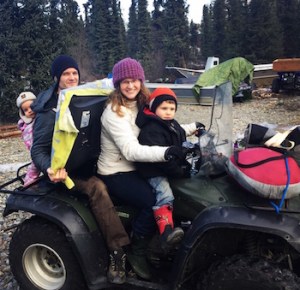
SuperBowlHondaThe only real differences between the Broncos fans of Port Alsworth, Alaska and those in the Promise Land that is Colorado? Well, there’s the fact that my friends delicately delivered their TV to my bosses’ house on their 4-wheeler with their toddler strapped to their back… and that we occasionally had to keep a rambunctious child from bumping the rabbit ears and disrupting our one precious TV channel that we (barely) were able to pick up the game on. Oh, and as the people of Denver took to the streets to celebrate the Bronco’s victory, we piled onto Hondas and drove the village, screaming and shouting in joy. (Evan, my bosses’ oldest even painted a Bronco on his chest and ran the runway shirtless. In February. With a Denver Broncos flag tied around his shoulders. Ohhh the embarrassing photos that I have tucked away for his some-day wedding slideshow…)

We have a wild crew of fifteen or so Coloroadoans who have all miraculously ended up in Port Alsworth through different missions agencies for just a time as this. The pre-game trash talking with community members (all in good fun), mid-game cheering, and post-victory celebration were all glorious and made me feel right at home. Until I didn’t…

Until I started watching the post-game awards and highlight reels online, using my precious internet just to watch my dad saunter back DadElwayand forth behind John Elway like the intimidating stud of a body guard he is.

Until I saw the photos of my grandmother, aunt, step-mom, and cousin at the game and after-party.

Until the Snapchat videos of my friends Wobbling in the streets of downtown Denver started coming through my phone. (Oh, how I love a good celebratory Wobble…)

Until I started texting with my dad, hearing what it was like to be at Levi’s Stadium during the biggest American sporting event of the year.

Admittedly, my heart was suffering from some hardcore FOMO (fear of missing out), but that feeling quickly gave way to an unexpected, overwhelming flood of grief. The sadness that nailed me right in the chest was so much less about missing a silly football game and so much more about the sudden realization that if I choose to continue following Jesus’ call to the nations, I’ll likely continue to miss out on the big (and small) moments of my loved ones’ lives– moments that I would otherwise be present for.

It hit me hard as I walked home Sunday night that had I not followed Jesus to Alaska, I would’ve been with my family in San Francisco, watching my dad live out virtually every American man’s dream. I would’ve been able to cheer for a team I couldn’t care much about, but I would’ve been in good company with the people I love most—my Raider fanatic family.

Instead, I’m here. Don’t get me wrong—I love nearly everything about my life in the bush. I love my job and my students. I love my stellar team at TLC and at the Tanalian School. I love my Gospel Community, running in the mountains outside my house after lunch, and the soon-to-be-spring nine o’clock sunrises. I love the opportunities that I’ve had in the last week to sit and listen to the stories of strong, Jesus-loving Native women from the villages that surround us. I mean, the Lord is BLOWING MY MIND with what He’s doing every day in rural Alaska, and I consider it such an honor to have been called to live in a place that is in a season of such dramatic transition.HGTWgroupBut there’s always been grief in that calling also; I’ve known that since the morning Jesus first called me here during a church service last Super Bowl Sunday. Foolishly (or optimistically perhaps…), I thought I had passed through the majority of the grieving process. I’m realizing more and more though, that by choosing to dedicate my life to Jesus and His call to go to the nations, that the struggle of missing out on the things and people I love will involve a life-long grieving process.

Of course, no matter where I am I’ll continue to celebrate silly Super Bowls, birthdays, and the weddings and new babies of my loved ones, but there’s a good chance that there will be seasons where those celebrations will be from a far (and will probably look more like taking a celebratory victory lap around a village on a 4-wheeler, than being physically present); a bitter pill for a quality-time, physical touch, people-person like me to swallow.

It’s a constant struggle, this reprioritizing of my heart’s desires so that following Jesus is higher than my desire to dance in the streets of Denver where I’m comfortable and happy. And as my FOMO and sappy, weak heart reminded me Sunday night, I am far from mastering the struggle.

The cost of being away from the ones I love is great; Jesus never denied that. But being a part of someone experiencing the freedom and love of Christ for the first time? Or watching a “violent” teenager’s heart soften because He’s reading God’s word every morning in Bible class? Or standing next to a girl who’s had books written about the violence and abuse that she’s endured in the Alaskan wilderness, but listening to her sing praises to our King at the top of her lungs with tears of joy streaming down her face? That is, and always will be, worth anything I could live with or without.

Jesus truly is better, and as the song goes, I need Him to make my heart believe that every. stinkin’. day.Girls(I suppose at the end of the day it helps alleviate my FOMO to know that one day I’ll hopefully be dancing with both my sweet Alaskan family and those I’m missing most on the streets of the New Jerusalem. And by George, we will celebratorily Wobble till we can’t Wobble any more…)



“But all through life I see a cross,

Where sons of God yield up their breath;

There is no gain except by loss,

There is no life except by death.

And no full vision but by Faith,

Nor glory but by bearing shame,

Nor justice but by taking blame;

And that Eternal Passion saith,

Be emptied of glory and right and name.”

-from Olrig Grange, by Walter C. Smith

Judas’ kiss: Lessons in betrayal and life

It was one of those “punch in the gut” nights that will likely be etched in my memory forever. One where, toward the end of the night, all I could do was laugh at the absolute absurdity of the situation at hand to remind myself that laughter and joy still existed, even though the darkness seemed to be winning.

I can still feel the way the bathtub dug into the back of my ribs as I sat outside it, wedged on the floor in the corner of a bathroom, stroking the hair of the violently ill, brokenhearted girl in my lap. After a few minutes, my laughter faded and I could hear my neighbor sitting outside the room, playing her guitar and beating back the spiritual darkness the way the Lord has gifted her most clearly– line by line, worship song by worship song. I leaned my head against the bathroom wall and sang along with her until I was crying so hard that words wouldn’t come out anymore.

I cried a lot that night.

I cried because my students were clearly hurting after the night’s events and their pain broke my heart. I cried because I was afraid, both of the natural consequences of my students’ actions and because I was afraid to be the “mom” of the situation– the one who would have to lovingly and logically discipline the students I adore. I cried because my expectations for the night had been broken, then seemingly lit on fire. But above all, I cried because the trust and relationships that I had been working to develop with my students had been shattered by lies and poor choices, and I felt incredibly betrayed.

Since coming to the TLC, I’d been warned of the “eye-twitch moment”, aka the moment when you lose control of your body from stress, exhaustion, or sensory overload, and your body starts to revolt against itself. That night, as I sat squished in the corner of a bathroom, holding one student and staring into the confused eyes of another who had come in to check on us, I blew past the infamous eye-twitch and graduated to the full-body rage tremor. My heart was indignant and overflowing with every emotion possible, but the only thing I could articulate was that I was hurt. And when I’m hurt, my Aztec heritage kicks in and my immediate emotional reaction is almost always ugly and hostile.

I wanted to scream, but instead I bit my lip, moved my eyes from those of my student to the floor, and in my best restrained mom voice, said, “Someday we’re gonna need to have a conversation about what happened tonight, but now is not that day. You’ve betrayed my trust and hurt me really deeply. You are forgiven and loved… but you should go…”.

That night, after the situation was mostly diffused and my students were in their respective beds, I knelt in my boss’ living room and bawled. “I. Don’t. Understand.” “I can’t trust them anymore.” “I don’t know what to do. I don’t want to give up on them, but I feel so betrayed. I can’t take it.” “I don’t know what to do. I don’t know what to do.” Fragmented sentences and bodily fluids poured out of me while my boss patiently listened and handed me Kleenexes.

“I know you’re really hurt by what happened tonight, but our calling is to go the extra mile with those Jesus has brought to TLC. And that’s what we need to do.” My boss gently responded over my heaving sobs before going on to explain a few practical ways that we could “go the extra mile” with them.

I sat and listened, seething and angry at my students, and angry at the ugliness of my heart while he spoke. When he was done, I managed to sputter out, “I CAN’T go anywhere with them right now, let alone go an extra mile; I don’t want to…”

Betrayal at its core is a break of relationship and trust. And it sucks.

Betrayal makes us indignant in our woundedness. It causes us to go to the darkest, most stubborn places in our hearts, sit down, and throw a baby fit. And that’s exactly what I did.

That night as I knelt on that floor and talked with my boss, I spun into myself, dug my heels in, and internally refused to move forward in trying to rebuild those relationships– essentially becoming the antithesis of the calling Jesus has given those who have felt betrayal within ministry (or in life in general).

I couldn’t see it as my emotion and exhaustion clouded my brain that night in December, but I was reminded in the days following that Jesus is a God who understands betrayal on the deepest level possible.

After all, Jesus was betrayed by one of his closest confidants, someone in His inner circle. He knows what it is to have His carefully built trust shattered. Within that, He showed His followers how we’re supposed to respond to betrayal through His interactions with Judas. (And last time I checked, His response wasn’t to throw a baby fit, cry, or purely dwell in the betrayal itself. Not that I would ever do any of those things… Ahem; moving on…)

Jesus responded to betrayal with grace and love. From the dawn of time, Jesus knew that Judas would betray Him, but that betrayal wasn’t without purpose; it was so that His Father’s perfect plan for reconciliation of man and God could be carried out.

Let me repeat that– Jesus knew Judas was going to betray Him from the get go, and yet He invited him into His life and His heart anyway. Not only did Jesus take a life changing risk in building trust that He knew would one day be broken and lead to His death, but He treated Judas with just as much love and grace as He treated His other disciples. So much so in fact, that when Jesus said that one of the people at the last supper was going to betray Him, everyone began asking who the traitor was.

Had Jesus treated Judas, the traitor, any differently than the other disciples I feel like that moment around the table would’ve included a painfully obvious (and awkward) shift of everyone’s eyes to Judas. Alas, it was a mystery who the traitor was until Judas showed up in the garden of Gethsemane with the Roman soldiers, servants, and Pharisees.

Jesus loved Judas well until the bitter(sweet) end and at a great cost.

But because He was just as human as He is God, Jesus also experienced emotion, there by reminding us that the pain of betrayal is real and something to be taken to God in prayer, rather than something to be brushed aside. We see in Luke 22:42 as Jesus called out to God, “Father, if you are willing, remove this cup from me.” that there was agony in Jesus’ knowledge that He was about to be betrayed. But the story doesn’t end with Jesus sitting in His emotion or agony; it “ends” (and I use the term ends in the loosest way possible here) with loving sacrifice in the midst of betrayal.

A month later, I’m able to acknowledge that the feelings that accompanied my betrayal were completely valid, but I also realize that dwelling in my emotions and battle scars cannot be the way this specific story ends either.

At the end of the day, I have to apply the Gospel to feelings of disappointment and betrayal when they come. Shaking them off and expecting them to disappear won’t work. Dwelling in them and refusing to move forward in relationship with my students doesn’t do anyone any good. And withholding future love because I’m afraid my trust will be betrayed again? That might be the easiest way out, but it isn’t what Jesus has called me to as His follower.

Jen Hatmaker says it so well in her book Interrupted: When Jesus Wrecks Your Comfortable Christianity:

“Jesus came to the foulest, filthiest place possible (earth), a place full of ungrateful, self-destructive people who would betray Him far more than they’d love Him (a whole planet of Judases). He became the offering for people who would slander His name with ferocity, yet His grace was theirs for the asking until they drew their last breaths, even if all they could offer Him was a lifetime of hatred and one moment of repentance.

We don’t get to opt out of this gospel. We don’t get to opt out of living on mission because we might not be appreciated. We’re not allowed to neglect the oppressed because we have reservations about their discernment. We cannot deny love because it might be despised or misunderstood.”

When the pain of betrayal comes, we have to look to Jesus and remember that ours is a God who understands betrayal, yet chooses to love anyway.

In fact, He chooses to love me, even though I kiss His cheek every morning and manage to wander away and betray Him for prettier, shinier, “more exciting” gods by lunch time every day. Yet His love for me is constant and perfect, unfailing and unafraid of my imperfection.

Jesus never promises us that we won’t get wounded in doing His work, but He does promise that those wounds and imperfect moments will become beautiful and for His glory if we give them to Him, (even if we don’t get to see this in this lifetime).

“As I have loved you, love one another.”

John 13:34

How do you decorate gang warfare for Christmas?

Last Christmas was a mess— a really dark, emotional mess.

On the morning of December 10th I made great plans to sweep the brokenness and messiness of holiday life under a rug, slap a tree on top of it all, and have a Merry-freaking-Christmas. My students and I were going to be happy and we were going to enjoy Christmas, dang it! (Can you see the crazy, plastered smile on my face? No? Just ask one of my DSS girls… I’m sure they can imitate it pretty well given how many times they’ve seen my crazy-teacher-eyes around the holidays over the years.)

The very same day that I made this proclamation of well intentioned, forced joy, my Christmas dreams were crushed by the murder of one of my students.

Losing Johnny broke me, and I subsequently kinda gave up on Christmas for a while last year. I battled between depression, and the urge to fight my feelings and simply “fix” said depression. I so badly wanted Christmas cookies and cheerful music to fix everything like it always seemed to in those stupid ABC Family Christmas movies. So, I tried to force a few cheerful traditions as an attempt to pull myself out of the darkness and pain. But the truth was, while they distracted me temporarily, none of those things could fix my aching heart or the hearts of the students around me. If anything, my inability to fix the situation just shoved me further into an emotional meltdown.

I'm not even kidding you; Christmas was so broken last year that even my Christmas cookies came out in pieces.
I’m not even kidding you; Christmas was so broken last year that even my Christmas cookies came out looking like a mess.

A year later, life looks drastically different in the weeks leading up to Christmas. (Can I get a hallelujah?!)

But even now, twelve months and twenty-five hundred miles removed from the events of last Christmas season, my heart still hurts. It hurts because I still don’t know how to appropriately grieve the death of an eighteen year old who was trying to turn his life around. (And I feel stupid– like after a year of wrestling with the consequences and darkness of gang warfare, I should have this figured out…)

My heart hurts because even in the middle of nowhere, I’ve got a lot of really real crap going on in my heart, and I know you probably do too.

It’s the holidays, and therefore I’m dealing with my annual child-of-divorce, “I’m-going-to-have-to-pick-which-side-of-the-family-to-disappoint-on-Christmas” struggle. I’m wrestling with a deep, selfish desire to avoid the conflict and pain I know I’ll be confronted with upon my return to Denver. I’m struggling to reconcile the fact that when I leave this village and return to the safe arms of my loved ones in three weeks, I’ll be sending my TLC students back to unsafe spaces to fend off the darkness on their own for a month.

I know I’m not alone in the mess. There are real things that we’re all struggling with, and newsflash: the struggles (at least my struggles) don’t ever seem to care whether it’s Christmas time or the middle of July.

Within these weird struggles of life I’m left with a lot of questions. Questions like:

If the pain of losing Johnny isn’t going to go away, even a year later, how do I decorate gang warfare for Christmas? How do I hide the pain that it has brought to my Street School family, or the unrelated pain that I’m feeling in my heart because of family struggles and relational breakdown? Should I even try to hide it at all?

Should I try to smother my heartbreak by wrapping it in Christmas lights and pretending that it doesn’t exist? That seems to be close to how the world tells me I should handle this internal battle, yet that “solution” doesn’t sit right in my soul…

But I think this is what we, as Christians, feel like we have to do.

Within the church we feel this need to be perfect, especially around the holidays. But I, for one, can’t be perfect; I’m completely incapable of it. And I’m sick of feeling like there’s something wrong with me for wanting to be real.

Yet even within my craving for authenticity, I still hesitate to bring up the places I’m struggling. After all, I don’t want to be the one to ruin someone else’s perceived holiday perfection with my mess. None of us want to be the broken, hurting ones in the midst of a season that seems to be the antithesis of such behavior.

There isn’t space for real life or real pain in the way our culture does Christmas. I think that’s such a shame because I’m pretty sure God doesn’t have His calendar divided into “times that are appropriate to discuss hard things” and “times that are to be devoted only to the drinking of hot chocolate, wearing trendy/ugly sweaters, and listening to Michael Buble’s Christmas album in the car”.

No. In His calendar, there is a time of longing for, and a time of receiving Jesus through His birth.

And friends, this season—advent—is that season of longing.

We all have really deep longings that match our questions and pain, and advent should be a season, just like any other, where we can express those within the safety of the church without someone trying to sweep us under the rug and shove a shiny Christmas tree on top of us and our problems.

Advent is a season devoted to waiting and wrestling, longing and hoping. It was not created to be a season devoted to aesthetic perfection.

This world isn’t perfect; I don’t think you need a church calendar to tell you that. But I think that it’s okay to let advent be a season of recognizing just how broken this world is. It’s okay to talk about the imperfections in our lives, because through acknowledging them, we can more deeply acknowledge our need for Christ and His coming–for the renewal that only He could bring to our brokenness, both through His birth in that manger two thousand years ago and in His someday second coming.

This advent and Christmas season, I pray that the church will be a people who make space for the brokenness (and broken people) in our lives, knowing that Christ has done the same for humanity. May we be a people who speak truth and light into the dark, complicated places of our lives, together. And as we wrestle with our brokenness and as creation groans, may we see Hope within poor circumstance, rather than try to forget that brokenness exists.

May we look to the soon-coming Christ, the reason for our confidence and Hope for redemption, deeply knowing that because of what He has done for us in His birth, death, and resurrection, that our sufferings will be lifted one day, for He is making all things new.

May we be a people that sees the Light in the darkness, acknowledging both, but embracing the truth that Jesus came to be the light that could never be extinguished.
As I light the advent candles in my home, know that I will always light them for you too, Johnny, just like we did in La Alma Park last December at your candlelight vigil. You are not forgotten. You never could be; you simply shined too brightly with that goofy smile of yours. Thank you for teaching so many of us what Light can look like in abject darkness.

“The people who walked in darkness have seen a great Light; those who dwelt in the land of deep darkness, on them has Light shone.”

(Isaiah 9:2)

I believe Love (and tacos) can conquer all

“Kacy, sometimes you open your mouth and say something, and I gasp. Because you get it. You’ve been there. Somehow you’ve lived parts of my story I thought no one person would ever understand.”

It was ironic to read those words in a note from one of my students this last week, given the fact that one of my worst fears in moving to Alaska was that I would never be able to relate to my new students. After all, what could I—a Brown, wild child, ex-hoodrat—possibly have in common with Native Alaskan teenagers from bush villages?

I was terrified coming here. I was scared that we would never find common ground, they wouldn’t like Mexican food… Or even worse, that my students simply wouldn’t like me. Could an approval junkie like me handle (and live in) that kind of rejection?

By the grace of God, my students and I have found more common ground than I could have ever hoped for in the last two months. (And after introducing my students to Mexican food and explaining that you don’t put soy sauce on Spanish rice, they’ve taken to my cooking. Even if they still spell quesadillas “Kacy-diaz”. Baby steps, right?)

Every night once my students are in bed, I lay down and scroll through a few online newspapers and my social media streams. In the last two weeks, I’ve watched in horror as terrorist attacks and subsequent political debates have unfolded on my tiny iPhone screen. As I lay under my blankets, in my warm bed in the middle-of-nowhere Alaska, my heart breaks for the world that we live in.

After all, I live in what could arguably be one of the safest places in the world.

Every morning I wake up in a village where the post master knows me by name and calls me to tell me when I have a package to pick up. I live in a place so safe and so quaint that if I’m hiking when the “grocery plane” lands, my neighbors put away my groceries for me; it’s just what we do here because this village is a family who lives for Jesus.

It kills me to read the news and be reminded that this is not the way of the world.

It pains my sappy heart to know that fear is driving hatred, racism, exclusion, and perpetuating foreign and domestic terrorism. But I suppose I shouldn’t be shocked… after all, as Carl Medearis (one of my favorite “Christian” authors) says, perfect fear casts out all love. Oh, wait… No, something is wrong there.

That isn’t the way of Jesus…

No, Jesus confronts fear with His perfect love. In fact, He confronted more than fear in His life (and death). Jesus confronted racism, sexism, pain, and shame all throughout His earthly ministry, but He did so specifically when He shared the Gospel with a Samaritan woman at a well in John 4:

“So Jesus came to a town of Samaria called Sychar, near the field that Jacob had given to his son Joseph. Jacob’s well was there; so Jesus, wearied as He was from His journey, was sitting beside the well around the sixth hour.

A woman from Samaria came to draw water. Jesus said to her, ‘Give me a drink.’ The Samaritan woman said to Him, ‘How is it that you, a Jew, ask for a drink from me, a woman of Samaria?’ (For Jews have no dealings with Samaritans.) Jesus answered her, ‘If you knew the gift of God, and who it is that is saying to you, ‘Give me a drink,’ you would have asked Him and He would have given you Living Water.’ The woman said to Him, ‘Sir, you have nothing to draw water with, and the well is deep. Where do you get such Living Water? Are you greater than our father Jacob? He gave us this well and drank from it himself, as did his sons and his livestock. Jesus said to her, ‘Everyone who drinks of this water will be thirsty again, but whoever drinks of the water that I will give him will never be thirsty again. The water that I will give him will become in him a spring of water welling up to eternal life.’ The woman said to him, ‘Sir, give me this water, so that I will not be thirsty or have to come to draw water.’” (John 4:5-15)

Jesus challenged man-made boundaries of racism here by talking to a Samaritan. *Gasp!* Then He got really risqué and pushed aside cultural taboos by crossing gender barriers and talking to a Samaritan woman. Even His disciples knew this was a big deal: “Just then, His disciples came back. They marveled that He was talking with a woman, but no one said, ’What do you seek?’ or, ‘Why are you talking with her?’” (John 4:27) They marveled at the fact that Jesus was loving someone so different from Himself… so foreign, so “lowly”.

Now, there’s speculation over whether this woman truly was an unlucky widow (several times over) or whether she was an adulterer or prostitute; We can speculate all we want on the facts here, but we will likely never know this side of heaven.

As a fellow woman, I can deduce however, that this woman likely wrestled with fear and shame if she had gone through that much deep, relational upheaval in her lifetime. And Jesus, knowing the depths of her heart more than I could ever begin to speculate, still chose to enter into her fear, shame, and brokenness to offer her the Kingdom of God anyway, even with the complicating circumstances of her nationality and gender.

I read this chunk of scripture and it causes me to pause. Every. Stinkin’. Time.

If this is the way of Jesus… And Christians are followers of Jesus… And I consider myself to be a Christian… What am I doing? What am I valuing in life if I find myself unwilling to cross uncomfortable barriers to love the ones He loved first?

If we as Christians claim to follow Christ, but are unwilling to follow Him across political, social, and man-made lines today in 2015, we are following something… but I dare say it isn’t Jesus.

Let me say it again: Jesus confronted the brokenness of the world with Love.

In the midst of the horrific headlines regarding terrorism and the political debate the rages on over the futures of refugees– real human beings what our world needs is the love of Christ.

We don’t need another political mandate, stricter man-made laws, or bloodshed to retaliate for bloodshed.

We need to love.

And we will never be able to love those whom we are afraid (or unwilling) to get to know. The Lord has shown me this first hand time and time again through scripture, and through moving me to the middle of the wilderness to do life with people that I thought couldn’t be more different from me, but whom He adores.

“Those people” whoever “they” are?

“They” are beautiful.

“Their” culture is rich with lessons, just waiting to be learned and loved.

“They” have been created in the image of God, just like you and me.

“They” need Jesus just as badly as you and me.

(“They” probably like Mexican food just as much as you, my students, and I do. [Just sayin’… I believe Jesus and tacos can unite the world…])

We’re all human, which unfortunately means we’re all a bit screwed up. But Christ came in PERFECT LOVE and died for all of us, that we might turn to Him and die to our sinful selves. To die to ourselves is to live for Him, and I don’t know about you, but it seems like living for the Jesus of the Bible means to love the people He has placed around us and love them as we love ourselves.

Scripture tells us the truths that His perfect love casts out fear and His strength is perfected in our weakness. But we, as the followers of Christ Jesus, have to be willing to humble ourselves and be His hands and feet; we have to be willing to invite in our poor and needy neighbors– those who live right down the road and (hold onto your seats) those who are foreign. 

Jesus was not an example of discrimination or exclusion, and thus I struggle to believe that we should walk those paths.

What would it look like for you to truly love those” people today? (“Those people”– whoever they are– probably aren’t as scary as you think. Trust me; I live in a house full of people I was terrified to meet.)

“By this we know love, that He laid down His life for us, and we ought to lay down our lives for the brothers. But if anyone has the world’s goods and sees his brother in need, yet closes his heart against him, how does God’s love abide in Him? Little children, let us not love in word or talk but in deed and in truth.”

“There is no fear in love, for perfect love casts out fear.”

(1 John 3:18, 4:18)