When the only path through grieving is… through…

On the heels of a year where the Lord taught me to live vulnerably in tight-knit community and through writing my heart out on this website, I came to a place at the beginning of last summer where words felt entirely inadequate to express the thoughts and emotions that flooded my body on a daily basis. In the span of two months, I had unexpectedly lost a dear friend, my “adopted little brother” in a motorcycle accident and a childhood friend to cancer. As I traveled last summer, I continued to journal and write privately, figuring that this lack of “words to share” would pass in due time.

When I resumed my “normal” life in Colorado in August, I felt strongly that I was being called into a season of silent processing with the Lord and I decided that a break from public writing was what I needed to do to respect that season of life. But as time here in Colorado wore on and transition turned to stability, my ability (and desire) to vulnerably share “where I was at” began to wane. Over time, I closed into myself, shutting nearly everyone else out so dramatically that most days I didn’t know how not to. (Aside: If I’ve done this to you, please, please, please know I didn’t mean to hurt you if I have. I want to sit down over a cup of coffee with you. I want to mend relationships. I want you to know that as much as it sounds like a cheesy relationship line or an excuse, “It’s not you. It’s never been you. It’s me. I’m a mess.”)

In the days that preceded the disappearance of my friends and our plane in December, I felt a shift occurring in my heart; I knew my season of silent processing was being called to an end. I knew I was supposed to start writing again. And yet, when the plane went down, a part of me went down with it. Obviously, the part of my heart that held Scott, Kyle, Zach, & Kaitlyn dear, but the articulate part of me was also lost that day.

For months, I’ve struggled with and through depression, trying and failing to express anything of real value without bursting into tears. Despite feeling the Lord pressing me to write or express my heart in whatever way I could, I couldn’t do it. Time and time again, as I’ve tried to write, I instead closed my laptop and retreated back into my own introverted brain.

In those moments, a part of me knew I was being disobedient to what God was calling me to in my grief. I knew closing myself off wasn’t a true solution to any of my problems, and yet in this complex season, I didn’t know how to stop.

Thus, I’ve spent my weeknights and weekends largely holed away from community, avoiding my laptop, and wrestling with the Lord in coffee shops and counseling, or while crying with my roommates on the Yarrow kitchen floor.

In the individual nights of these last few months I’ve felt the extent of just how little I have “it” together (whatever “it” is…). And to be honest? This realization of the extent of my weakness paired with this “calling” to be vulnerable in that weakness?? It’s scared the living daylights out of me.

I don’t know what to say. I don’t know how to say it. I don’t know how to not tell other’s stories while telling mine because they’re so intertwined. I’m scared of unintentionally drudging up pain for the people I love, those who are walking through this complicated season of grief too. I don’t want to be “that sad writer” or ever come across as though I’m seeking pity, because I beg you to realize, I’m not. 

I so desperately want to feel “normal” again. I want to stop crying. I want to stop grieving from the core of my being.

But that’s not where the Lord has me… 

Instead, I’m here in this weird in-between– the place where I thought I was finally “okay” enough to attend a symposium on gospel-centered grieving and most days am more hopeful than I am bitter with God.

I’m here, in the muck and the mire of loss and redemption, joy and grief.

I’m desperately seeking contentedness with God’s plan when in actuality? I feel like I can’t handle being content with this new reality without the people I love. And the mere thought of trying to do so spiraled me into a panic attack Friday night at said grief symposium where I ended up running out of the sanctuary and ugly crying/ snotting into a close friend’s hair on our church steps.

This season isn’t cute.

It’s rendered me a mess. One giant freaking paradox.

Yet daily throughout this season, I have heard the invitation of Jesus to the weary in Matthew 11– “Come to Me.” And privately, I have. Through His sweet grace that I know I possess and yet so desperately crave more of, I come to Him a little more each day.

Today’s come to Jesus moment has been through obedience and tears; it is through a long overdue introduction/ continuation to this convoluted season through writing although I’d much rather remain silent and still, alone with Him and my little blue journal.

It comes through breathing life back into this dusty, neglected blog and it comes in the same vein as the words I’ve read time and time again this year: “The only way out of grief is through.”

Part of me hopes that maybe writing again will be the beginning of the end of this messy chapter. Most of me knows that more than likely it’s not; but I simply hope am confident that somewhere in this mess, in this journey through grief, I will see more of Jesus and I pray somehow you do too…

{To be continued}

“I remain confident of this: I will see the goodness of the Lord in the land of the living.”

(Psalm 27:13)

“Oh Holy Night, the weary soul rejoices…”

I’ve spent the morning curled up on the Yarrow House sofa here in Denver. Six different versions of “Oh Holy Night” have looped on my Spotify as I’ve sat, staring vacantly at our Christmas tree and the Bible in my lap. No matter how long I look at either, I’m unable to reconcile myself to the joy that either thing should bring me in this season of Advent.

It was on this day two years ago that one of my Street School students was killed in gang warfare. And even though it seems like two years have passed, it was just last night that we received what I still can’t bring myself to believe is the final word that four of my loved ones in Alaska likely won’t return home after their plane went missing on a flight from our village to Anchorage Wednesday.

On December 10th, a day that has already been agonizing these last two years, I admittedly have been struggling with feeling more helpless and hopeless than ever. I long to be able to fix something. Anything. I long to be 3,500 miles away from this sofa, embracing my dear friends in Port Alsworth whose lives have been forever changed by a routine commute that turned into all of our worst nightmare.

My heart breaks more and more for those I love with every text, phone call, and update I receive because I know there is not a single one of us from that beautiful little bush village unscathed by this tragedy. Within that heartbreak I have heard the screams and cries of my friends who have lost members of their family and there simply aren’t words for, or to say in response to, that kind of suffering or pain.

Even though I am in the city where Johnny died, physically close to those affected by that tragedy two years ago, I am incapable of doing anything to change the situation here either. We will never be able to bring him back, answer the still-outstanding questions, or heal the residual pain his family, my students, and our Street School staff still feel.

As my mind has swung between these tragedies, desperately trying to make sense of something, the only conclusion I’ve reached is this: Never in my life have I felt such a deep ache for Someone to save me or the people I love from the pain and brokenness of this world. Never in my life have I longed so deeply for a Savior. 

While my heart can’t seem to consider celebrating anything right about now, I know the truth: we will soon celebrate the fact that our Savior has already come.

The Bible in my lap, my brothers and sisters (near and far) who have prayed and cried with me this week, the song that keeps repeating itself over my computer speakers, and even the silly cultural tradition of sticking a dying tree in our living room and wrapping it in lights point me back to that truth–

Our Savior has come. Christ came, incarnate as a helpless baby, and died as the Most Powerful King to save us from both our sin and our sorrow. Past, present, and future.

Two thousand years ago He became Emmanuel and Emmanuel He is still.
God with us.
God with all who mourn.
God with all who weep.
God wrapping His arms around every person who knows and loves Port Alsworth, the Longerbeams, the Bloms, and Johnny’s family.
God indwelling in those of us who call Him Abba, Father.
God who came to rescue.
God who will make all things new.

And thus I proclaim over my own trembling heart and that of those around me, that even as the news we receive today and this week will likely worsen by earthly standards, the good news that Christ has come for us and can wrap us in His arms now and for eternity is. indeed. Good. News.

Even if everything else falls apart, His sovereign plan, loving promise, Good News, and ultimate sacrifice remains the same– it is the only Good News we could ever truly need.

“Oh holy night
The stars are brightly shining
It is the night of the dear Savior’s birth
Long lay the world in sin and error pining
Till he appeared and the soul felt its worth
A thrill of hope the weary soul rejoices
For yonder breaks a new and glorious morn

Fall on your knees, Oh heart the angel voices
Oh night divine, Oh night when Christ was born
Oh night divine, Oh night, Oh night divine

Truly He taught us to love one another
His law is love and His gospel is peace
Chains shall He break for the slave is our brother
And in His name all oppression shall cease
Sweet hymns of joy in grateful chorus raise we,
Let all within us praise His holy name!

Christ is the Lord, Oh praise His name forever!
His power and glory evermore proclaim

Fall on your knees, hear the angel voices,
Oh night, Oh night, Oh night divine.”

img_1705

Oh, Jesus. Make our hearts believe. Make our hearts believe while we are here on our knees…

~~~

If you, like me, wish you could do something but don’t know what to do, you can donate to any of the Go Fund Me accounts below. The first two are to help cover memorial service/funeral costs for the Blom and Longerbeam families. The last is to help some of the Bloms’ dear friends make it to Alaska for Scott, Zach, and Kaitlyn’s celebration of life.

Blom family memorial service / out of state family travel expenses

Kyle’s memorial service / family travel expenses

Help send the Brent/ Boe families to Alaska

Steam & shame: Unexpected gospel lessons in a 200 degree room

“My girls want me to “steam” with them today. AKA how people in the villages traditionally bathe. Together. In a 200-something-degree room. Did I mention: Together. As in: With. Other. People. Can we just talk about the fact that Jesus is pushing on ALL of my insecurities in Alaska?! I didn’t sign up for this. Help.”

While I understand that discussing public bathing may be running the risk of over sharing here, I beg you to stick with me…

You see, I sent that text message to friend back in Colorado last fall on the afternoon I was introduced to the “maqii” (or steam).

One of my sweet Native friends, Yvette, had come to TLC the week before to present for our Native culture night. She spoke to two very different groups within the ten or so of us seated around the table:

To my native students, she explained the intricacies and traditions of her people, the Dena’ina— a people group with incredibly similar customs to my Yup’ik and Aleut students. She told them the legends that her grandmother had told her—legends involving the ‘powers’ of bears and eagles and other wild creatures that are so intertwined with almost every aspect of Native culture. She told stories about growing up in the nearby village of Nondalton, as well as tales of the family legacy she carries on by drying and canning hundreds of salmon every summer and butchering moose in the fall. I sat at the end of the table and watched as the students I was just getting to know shook their heads and smiled their sweet, shy smiles of understanding and agreement as she spoke.

Then to those of us Alaskan newbs, she explained everything from Akutaq (Native “ice cream” consisting of frozen berries, fish, Crisco, and sugar), to what a normal day would look like for someone living in a traditional village. I leaned back in my chair, drinking in everything she said.

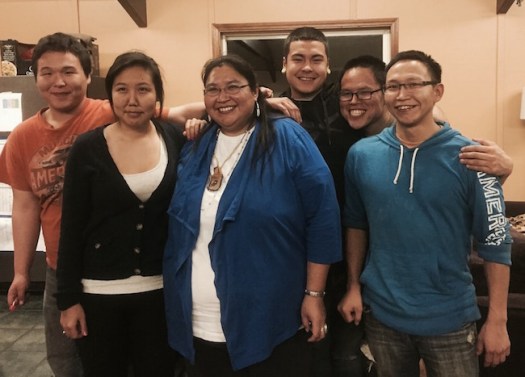
nativeculturenight
Yvette with the 2015-2016 TLC students

“Where I come from, and when I was growing up, all of the women and all of the men of a family would bathe with their respective genders, together in a steam bath.”

She paused to laugh at my awkwardness as I nearly fell sideways out of my chair from shock, then embarrassment.

“When I tell non-Natives that, I get really uncomfortable or horrified looks… kinda like the way Kacy’s looking at me.”

All of my students immediately glanced my way and smirked as I turned a shade of red I thought was impossible for Mexicans to turn. Thankfully Yvette let me off the hook and quickly continued on.

“The steam was a place of vulnerability—where the elder women would talk amongst themselves or pass down knowledge to younger girls. There wasn’t a single topic that was shameful or off-limits in the steam; that was how we were raised. But I’ve noticed that something has changed in the generations that have come after mine.

The younger women, they don’t want to steam with the older women any more. They find it more awkward and less of a part of our culture. I think it has a lot to do with the fact that young women have more pressure these days to be or look a certain way… And just like they don’t steam with the older women, the girls don’t talk to the older women the way we used to when we were kids. There’s a disconnect within our people between the generations. There is a segregation because of shame.

Our young women don’t feel comfortable in their own skin. They don’t feel comfortable enough with who they are (or aren’t) to ask the hard questions of life or receive the potentially uncomfortable wisdom of an elder. It makes me sad to see the way shame is stealing our people.”

As I processed Yvette’s words within the “honor-versus-shame” Native culture of TLC, my perspective and definition of shame began to shift. Over time I came to realize that at its core shame is a deep-seeded feeling of not being good enough, a feeling that proceeds to tell us that we are defined by our lack, rather than our bounty and beauty in Christ. A feeling that the enemy uses to steal our identities in Christ and lead us away from the Lord.

Whether we are willing to admit it or not, we all struggle with feelings of not being good enough, smart enough, thin enough, x-y-z enough everyday.

Some of this shame and our wrestle with “enough-ness” stems directly from lies that we’ve been told by our instantly photoshop-able culture. There’s an influx of subliminal messages about “health” standards (physical, mental, spiritual, or otherwise) nearly everywhere we look and the temptation to compare ourselves, then shame ourselves when we fall short of these often unrealistic standards can be all-consuming.

But there’s another type of shame—what many counselors would call “legitimate shame”.

This feeling stems from engaging in activities we know aren’t healthy for us, or don’t fall in line with our morals or beliefs about who God is or who we’ve been created to be, then falling prey to hopelessness when we contrast our imperfections and shortcomings with a perfect God.

We all wrestle with shame (“legitimate” or otherwise) due to our sin and imperfect, fallen decision making and that of others. But, despite what the world or the one trying to destroy us may try to lead us to believe, Yvette’s poignant words have been a constant reminder that to me that as believers we don’t need to sit isolated in either of these types of shame.

Yes, as Romans 3:23 tells us, “we’ve all fallen short of the glory of God” because we’re sinners, but what I constantly need to remind myself is that the Gospel doesn’t end there.

Within our wrestle with sin and shame we have two choices:

1) We can allow our sin, shame, and fears to define and confine us

OR

2) We can trust that Jesus is who He says He is– the loving Savior of the world, sent to reunite us with our Heavenly Father– and trust in the grace He freely offered us on the cross while we were still messy and broken, drowning in the sin that rightfully shamed us. And by accepting, then living in His love, we can allow Him to loosen the bonds of shame that seek to keep us defined by our lack of perfection.

It’s easy (okay, easier) for me to express this a year, some perspective, and several steams after the fact, but as I sat around the TLC table, listening to Yvette speak about the cultural power of the steam bath and the bondage of shame last fall, I bristled internally and thought, There is nooooo wayyyyy I’m ever going to sit in a hot room, physically exposed for an hour, exposing the inmost fears and insecurities of my heart with other women. No. Way. After all, Jesus came so that I wouldn’t have to suffer through hell… and all of that sounds like my personal hell.

So, when my TLC girls asked me to steam with them last November, I’m fairly certain I made the same terrified face I’d made at Native culture night. “Suuuuuuuuure….” I hesitated, using all of my emotional energy to turn my grimace into a semi-excited smile. As my girls went to pack their bags for the steam, I immediately grabbed my phone and fired off the panicked text above to Kitty.

In that moment, the shame and insecurity I felt about my awkward, lanky body and my fearful heart being exposed was fighting to confine me and keep me separated from my girls and my new friend. This illegitimate shame based in insecurity had me sucked so far into my own brain that I couldn’t hear God gently telling me the same thing He’s told me everyday for the nine years I’ve walked with Him:

You are mine. You are loved. You are beautiful. I created you to be uniquely you. You are enough. Do you hear me? You are enough. You have nothing to be ashamed of. I have died for your sins. I have taken on your filth. You are clean. You are pure. You are my beloved bride. You are enough because of who I am.

And that is the truth that I am fighting tooth and nail to keep at the forefront of my mind these days.

Because the truth is we need not be ashamed of exposure and vulnerability– not before God and not before one another– because Christ has seen the depths of our sinful hearts and yet in His infinite love for us He still took on the weight of our sin and died, abolishing the line between us and God that allowed for sin and shame’s power to confine us.

So, brothers and sisters, whatever shame you are fighting today, “legitimate” or otherwise, may you know that in it you are unconditionally loved. May you know in the marrow of your bones that your sin is not what defines you if you have invited Christ to wash you white as snow. 

Your mess is His, and if I may be so bold, your mess can be mine too. You are I are both imperfect and insecure, my dear. We’re in this battle together.

And in that, may we be a generation of Christians who believe so strongly in the redemptive power of Christ that we offer our hearts and minds completely to Him, allowing Him to break the segregation and confines of shame in our lives. May we sit with each other over coffee (or in 200-something degree rooms) and confess our imperfections and insecurities, reveling in the fact that we, the beloved ones of a perfect God, have already been washed clean.


Fireweed and God’s Faithfulness

I didn’t sleep that night in May.

Instead, I sat next to my best friend in Alaska and wept as she held my credit card and booked me a flight back to the Lower 48. I read and re-read the news articles that confirmed my worst fear. I deliriously walked circles around the village at 2 AM, and again at 4 AM, in the near-24-hours of summer sunlight. I wrote last minute goodbye letters while my laundry tumbled in the dryer. At one point that night, I knelt on Heather’s living room floor and sorted my belongings into three piles:

Books to ship to Colorado.

Clothes and gear to pack back into my suitcases.

Things that didn’t fit in my suitcases to burn.

Everything seemed surreal as panic attacks and and waves of uncontrollable crying washed over me. The text I’d gotten at exactly midnight that night had undone me entirely. It was the text that brought my time in Alaska to a close two weeks earlier than I’d anticipated and put me on a plane to Iowa to be with my “adoptive” family after an unexpected death.

In my final hours in Port Alsworth, I walked outside with my arms full of my “burn pile”– clothes that had been loved-to-death in Alaska, odds and ends that wouldn’t fit in my luggage, and books I couldn’t pawn off on anyone– and I threw them in a burn barrel. With tears streaming out of the corners of my eyes and freezing on my cheeks, I lit my torch and touched it to the items I loved. I watched the fibers of my once-favorite sweater smolder burgundy, then blue. I touched the flame to the corners of a few books that protruded from the side of the pile. As the wind shifted, the small fires slowly melded together to form one giant flame. I stood there mesmerized by the fire, overcome by another wave of panic and grief. I’m leaving Alaska. Today. This can’t be happening. This wasn’t supposed to end like this.

It really wasn’t. I’d planned to leave Alaska just before Memorial Day with a girlfriend of mine. She’d bought a car in Anchorage and I’d bought a map of Canada off of Amazon. We’d planned to road trip from Anchorage, down through western Canada, to Seattle. We had dreams of adventure and excitement, photo ops, camp outs, audiobooks and a lot of awkward car dancing. Kathryn and I had traced our route not three days before; we had a plan, but it seemed that God had another. And honestly, I hated this plan of His…

That’s all I could think as I stood there staring at the flame that had now engulfed my belongings, slowly turning them into a pile of ash and embers. 

I don’t know how long I stood there in a trance watching that fire. All I know is that a text from the friend who’d arranged my flight into Anchorage snapped me out of my delirium: You need to leave earlier than planned. ASAP. The weather’s getting worse. Can you come now?

I hugged the few people I crossed paths with on my way through the village. When I got to the plane, I huddled under its wing with the few friends and members of my team who’d gotten the memo of my earlier-than-early departure. We cried and prayed and hugged, and before I knew what hit me, the plane was wheels up, flying out of Port Alsworth while I ugly cried in the back seat. Thick fog hid the blue glacial water that my heart loved so much. When I looked back to see my Alaskan home for what felt like the last time, all I could see was a thin column of black smoke coming from the burn barrel that once held my belongings.

It’s probably the combination of sleep deprivation, shock, confusion, over-caffeination, grief, and loss, but most everything I remember from May 21st seems enlarged and uber traumatic– as if I survived a wildfire instead of an unceremonial burning of a few of my belongings and an unexpected move. And most of this summer was colored by that day and metaphor.

Months later, I sat with my roommate in Denver and sobbed. “I just feel like I’m on fire all the time… And ya know what sucks?! Even in the rare moments when I don’t actively feel like I’m on fire, I feel like I could spontaneously combust at any moment. I’m ready to stop grieving and crying and feeling all of these feelings. I’m sick of it. I’m done.” 

“God’s refining you, Kace. I know you’re sick of this season, but from the outside I can see the ways He’s working and it’s beautiful… even if it hurts and is a little bit, okay a lot, like He’s refining you with fire. ”

For months I’ve fought situational depression to feel more like myself and less like a pile of smoldering ashes left behind after a wildfire. And oooooh some days it has felt like I would never be myself again.

But in God’s infinite grace and goodness, He provided an opportunity (and the airline miles/funds) that allowed me to return to Port Alsworth this last week over my fall break to surprise the ones I love there so dearly.

This time around there were tears of joy as I said an unexpected hello instead of tears of sadness as we said an unexpected goodbye. I warmed my hands over campfires with friends instead of crying over burning belongings. At one in the morning, I stood on Heather’s guest bed next to her and looked out the window for the Northern Lights instead of sobbing on her floor as she booked me a flight to Iowa. There was simply so much sweetness and redemption in Him allowing me to spontaneously return to Port Alsworth. (I’m still overwhelmed by the way He loves me and cares about the simple desires of my heart.)

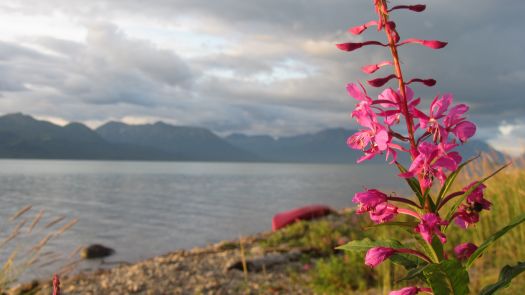
As I left Alaska on Saturday, a friend of mine (completely unaware of my five-month wildfire analogy) pressed a tiny packet of seeds into my palm and simply said, “You’ve said you feel like God is calling you to plant a garden and stay a while in Denver, right? Maybe that garden needs some Alaskan fireweed…”

I smiled and flipped the seed packet over in my hand. As I read the bold print on the back, I knew in an instant that she couldn’t have been more correct given what that little packet said:

Alaskan Fireweed

(Chamerion Angustifolium)

Alaskan fireweed is often seen as a symbol of life and rebirth in the Alaskan Native culture. Fireweed is often one of the first plants to grow in the ashes after wildfires in Alaska.

Anna_Fireweed.jpg
Photo credit: Anna Burrows

The Lord is faithful to bring beauty from ashes, even when His timeline is so clearly not my own. He is faithful to work all things for His glory and the good of those who love Him (Romans 8:28)– Trial and sanctification by wildfire, transition, death, and grief included.

After all, there is nothing too permanent for the Lord to redeem, too far out of His reach or too big for Him to handle, or too burnt out to revive.

Thank you Jesus, for You continue to redeem my soul from the pit of emptiness.

“Remember not the former things, nor consider the things of old. Behold, I am doing a new thing; now it springs forth, do you not perceive it? I will make a way in the wilderness and rivers in the desert. The wild beasts will honor me, the jackals and ostriches for I give water in the wilderness, rivers in the desert, to give drink to my chosen people, the people whom I formed for myself that they might declare my praise.”

(Isaiah 43:18-20)

A hyperbolic WebMD-esque perspective on homesickness. Also, Jesus.

My mind and heart have been at war Monday through Friday at approximately 6:45 am for the last three weeks.

You see, about five minutes into my morning drive to work, I have a choice to make: I could merge right, onto the I-70 on-ramp and head to Denver International Airport, or I could continue driving south down Wadsworth Boulevard to my classroom. Every morning thus far I’ve made the sane choice; I’ve gripped my coffee cup, exhaled, and driven past that on-ramp to the Street School.

But as I drive past the interstate and inevitably get stuck at the traffic light just past the on-ramp, I let the same daydream unfold in my mind every morning. In it I’m whipping my car around in traffic. I’m racing home, throwing everything I can fit into my biggest suitcase, throwing said suitcase into my car, peeling out of my driveway, and merging onto that on-ramp on my way back down the street. Forty-some minutes later in this fantasy, I’m abandoning my car in the departure lane at DIA, running to the ticket counter, and breathlessly requesting a ticket for the first flight I can catch to Alaska.

It’s become an everyday, conscious decision not to give in to my fantasies, pull onto that on-ramp, and spontaneously fly back to the little Alaskan village that captured my heart while simultaneously undoing everything about who I thought I was.

In all the times I’ve moved and all the places I’ve lived, I never really understood homesickness. In Alaska, I often said I was “people-sick”. I missed the people who held my heart here in Colorado– my family, my church, my DSS students– but I rarely missed the hubbub of city life or the bizarre-o hipster culture of Denver that I slide back into all too easily when I’m here.

But this homesickness for Alaska? It’s unshakeable. I miss my new-found best friends and my Gospel Community. The laid back culture. The “it’ll probably be fine” attitude that somehow seamlessly meshes with the tough Alaskan ingenuity that is essential for survival in the bush. I miss trail running in the mountains and having coffee with Jesus on the pebble beach in my backyard in the morning. I miss the simplicity of life and the canned moose that lined my pantry. I miss flying as pilot-in-command and as a passenger whenever mail runs to the next village down needed to be done…

This homesickness isn’t mild– no, it truly feels like an illness that started in my heart, infected my blood, and has made its way to my bones. In the hyperbolic metaphor and picture in my mind, there’s a WebMD site listing the side effects of my disease. It reads:

Homesickness

Homesickness is a disease plaguing disheveled in-transition missionaries, expats, and school-age summer campers alike. There is no known cure for homesickness, other than to “rub some dirt on it” and “suck it up”.

Symptoms can include:

  • Daydreaming. Excessively.
  • Staring at the roundtrip ticket’s worth of frequent flier miles in your Alaska Airlines account far too often.
  • All too realistic dreams in which you’re back in your little village. (These dreams may lead you to wake up in your actual location and irrationally sob into your pillow.)
  • Sensory overload leading to intense introversion…leading to more daydreaming. [Are you sensing a theme here yet?]
  • Struggling not to reminisce while having coffee with Jesus in your classroom instead of on the beach. (This may also lead to sobbing… It seems to depend on the day.)
  • Recalling only the beautiful events that occurred while living somewhere– not the situations that almost killed you.
  • Oh. And in some incredibly severe cases, death.

Yes, like I said, the metaphor is hyperbolic. But oh, does it seem to be a little less-than so some days.

Logically, I know I’m not going to die from this bout of homesickness, but sometimes the pain that shoots through my heart as I pass that on-ramp makes me wonder…

Why am I still so attached to the little one-square-mile of tundra in the scenic middle of nowhere called Port Alsworth and it’s two hundred inhabitants? Is this pain a sign that I will one day return to the Alaskan bush? Will this inability to keep my head out of the clouds lead me back behind a yok and into the sky as a missionary pilot someday? Will the dreams (day or night alike) ever stop? Will the jarring sense of transition ever quit? Or am I forever doomed to feel homesick and homeless all at the same time?

As I’ve sat at that stoplight morning after morning, wrestling to keep my steering wheel straight and my mind off the millions of questions buzzing in my brain, the Lord has continuously led my thoughts back to the book of Exodus. After all, what is Exodus if it’s not a story of being led into the wilderness and back out again?

As I sat, reading in the corner of one of my favorite coffee shops Sunday morning, it was as if for the first time in months, my homesick/daydream-y brain was able to make sense of scripture.

In the second chapter of Exodus, Moses has not yet come to save the Israelites from their famous slavery. In fact, he hasn’t even been called to “ministry” yet. Life is simply normal and hard, and both Moses and the people of Israel are feeling the weight of their circumstances.

“During [the days of the Israelite’s captivity in Egypt], the king of Egypt died, and the people of Israel groaned because of their slavery and cried out for help. Their cry for rescue from slavery came up to God. And God heard their groaning, and God remembered his covenant with Abraham, with Isaac, and with Jacob. God saw the people of Israel—and God knew.” (Exodus 2:23-25)

I can only imagine the Israelites were homesick. They wanted their old way of life back; they wanted normalcy and freedom. They groaned and cried out to God and scripture reminds us that He heard them. He remembered them in the midst of their sorrow and wrestling. He saw them. And above all, He knew what He was going to do with and through every single circumstance and trial.

As I read and reread those verses, oh, how my perspective on homesickness shifted. When I took the time to consider that in the midst of my wrestling and sadness, I am seen and loved and remembered by the Most High God… That He is the same God who knew and still knows what He is going to do in the lives of all of his children– in the lives of the Israelites thousands of years ago and in my life now in 2016 and beyond… It was a realization that somehow changed everything.

Sure, my heart is still hyper-aware that it doesn’t belong in Colorado, but that doesn’t necessarily mean it belongs in Alaska either… In the words of C.S. Lewis, “If we find ourselves with a desire that nothing in this world can satisfy, the most probable explanation is that we were created for another world.” 

I wasn’t created for Alaska or Colorado; I wasn’t created for this world anymore than you were. I was created to be with the One who hears me senselessly crying alone in my classroom when no one else does. I was created to be in perfect union with the God of my Fathers– the One Who remembers His promises to Abraham, Isaac, and Jacob and makes good on them daily, thousands of years after their deaths.

In reality I know I’m not homesick for Alaska, even though I am. (What a fickle heart I have.) No, I’m homesick for my Jesus and for heaven– for that coming world where the perfection of Christ reigns and where I will be with Him. 

The scribbles in my journal from that little Denver coffee shop are simple (and poorly punctuated, but I digress).

My heart longs for you, alone, sweet Jesus. For Your stability. For my one true Home. To be in the presence of Your fullness. And I know that day will come because You are faithful and true. You are making all things new. And as it says in Exodus 2:25, You know. You know the depths of my conflicted heart, but also the complete and utter goodness of Your unfolding plan. 

I simply need to breathe through the illness and trust the words I so often say to my students in my best church lady voice… ‘Jesus knows, child…. Jesus knows…’ and ‘You probably won’t die…’

Because those promises are enough. Because You are enough. No matter the circumstances or my location.”